
Quick Answer
- Key Takeaways
- What Is a DePIN Blockchain Token?
- How We Selected the Best DePIN Tokens to Buy
- Top 5 DePIN Blockchain Tokens to Buy Before the Next Bull Run
- 1. Bittensor (TAO) — Best AI DePIN Network
- 2. Render (RENDER) — Best GPU Computing Token
- 3. Filecoin (FIL) — Best Decentralized Storage Network
- 4. Akash Network (AKT) — Best Decentralized Cloud Computing Platform
- 5. PhyChain (PHYCHAIN) — Emerging Distributed Computing Infrastructure
- DePIN Token Comparison
- Which DePIN Token Has the Most Upside?
- Conclusion
- Frequently Asked Questions
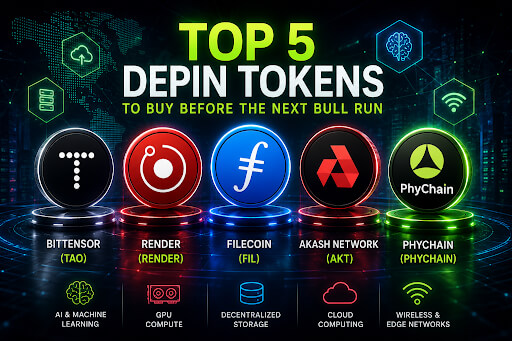
DePIN (Decentralized Physical Infrastructure Networks) connects blockchain incentives with real-world services like AI computing, cloud hosting, storage, and wireless networks. For investors preparing for the next bull run, Bittensor (TAO), Render (RENDER), Filecoin (FIL), Akash Network (AKT), and PhyChain (PHYCHAIN) offer strong ecosystem exposure, balancing established adoption with emerging growth opportunities.
Key Takeaways
- DePIN crowdsources physical resources into decentralized infrastructure secured by blockchain technology.
- AI and cloud demands are rapidly accelerating decentralized compute adoption.
- Bittensor leads decentralized AI, while Render and Akash capture surging global GPU and cloud computing needs.
- Filecoin remains the largest storage player with a mature network ecosystem.
- PhyChain is an emerging project aiming to transform idle consumer smart devices into distributed compute nodes.
DePIN allows individuals to rent out spare computer storage, GPU power, or internet bandwidth and earn cryptocurrency in return. By crowdsourcing hardware globally, DePIN may reduce reliance on centralized data-center infrastructure like Amazon Web Services (AWS) or Google Cloud, though it does not fully eliminate infrastructure costs. Driven by the global explosion of AI, cloud computing, and IoT, DePIN has established itself as a multi-billion-dollar crypto pillar backed by real-world utility rather than pure speculation.
What Is a DePIN Blockchain Token?
A DePIN token powers decentralized physical networks by rewarding hardware providers who contribute computing, storage, or wireless resources.
This token incentive model allows networks to scale quickly and offer services at a fraction of legacy corporate costs. Major categories include:
- AI & GPU Computing: Supplying on-demand processors for machine learning.
- Decentralized Storage: Distributed alternatives to centralized data centers.
- Cloud & Edge Computing: Location-independent, flexible hosting capacity.
How We Selected the Best DePIN Tokens to Buy
We evaluated the top DePIN projects using four core metrics:
- Real-world utility: Active network usage and developer adoption.
- AI and macro exposure: Alignment with structural tech trends (e.g., global GPU shortages).
- Token economics: Clear token utility, staking mechanisms, and healthy liquidity.
- Risk vs. reward: A balanced blend of industry blue-chips and early-stage growth assets.
Top 5 DePIN Blockchain Tokens to Buy Before the Next Bull Run
1. Bittensor (TAO) — Best AI DePIN Network
Bittensor is a decentralized market for machine learning where specialized subnets collaborate and compete to solve complex AI problems.
- Current Price & Market Cap: Around $215–$216 USD, with a hard cap of 21 million max supply and approximately 11.08 million tokens in circulation.
- Primary Use Cases: Decentralized machine learning and AI model training.
- Why Investors Are Watching TAO: It offers an open-source alternative to big-tech AI silos, featuring tight tokenomics that mirror Bitcoin’s structural scarcity.
- Risks: High technical complexity; requires enterprise clients to sustain long-term demand.
2. Render (RENDER) — Best GPU Computing Token
Render connects digital creators and AI developers with idle GPU computing power distributed around the world.
- Current Price & Market Cap: Around $1.59–$1.60 USD, with a market cap of roughly $824M–$833M.
- Primary Use Cases: 3D rendering, AI model processing, and motion graphics.
- Why Investors Are Watching RENDER: Fueled by global AI demands, Render directly capitalizes on the structural scarcity of high-end graphics processors.
- Risks: High price sensitivity to broader AI market volatility.
3. Filecoin (FIL) — Best Decentralized Storage Network
Filecoin is a prominent Web3 storage pioneer that converts unused hard drive space into a secure, verifiable global data market.
- Current Price & Market Cap: Around $0.79–$0.80 USD, with a market cap of approximately $630M–$632M.
- Primary Use Cases: Enterprise data archiving and decentralized website hosting.
- Why Investors Are Watching FIL: The Filecoin Virtual Machine (FVM) has added smart contracts, bringing decentralized cloud compute directly to stored data.
- Risks: Historical downward price pressure from token unlock schedules.
4. Akash Network (AKT) — Best Decentralized Cloud Computing Platform
Akash acts as an open cloud marketplace, allowing users to safely lease out idle data-center capacity to developers needing flexible hosting.
- Current Price & Market Cap: About $0.63–$0.64 USD, with an implied market cap around $185M based on roughly 295.42M circulating supply.
- Primary Use Cases: Censorship-resistant server deployment and low-cost GPU renting.
- Why Investors Are Watching AKT: Official documentation states Akash can deliver up to 85% lower costs than traditional cloud providers, which highly appeals to startups.
- Risks: Operates in a highly competitive cloud computing niche.
5. PhyChain (PHYCHAIN) — Emerging Distributed Computing Infrastructure
PhyChain is an early-stage project within the BNB Smart Chain ecosystem targeting everyday smart hardware.
- Current Price & Market Data: Phychain price around $0.0027–$0.0041 USD depending on the data source, with a market cap that is not consistently reported and relatively limited liquidity.
- Primary Use Cases: Localized edge computing and decentralized application hosting.
- Why Investors Are Watching PHYCHAIN: Using its Distributed Resource Activation Protocol (DRAP), PhyChain aims to turn everyday smart devices such as phones, routers, and wearables into decentralized computing nodes that contribute idle resources to earn network rewards.
- Risks: Early execution phase, smaller developer ecosystem, and higher trading volatility.
DePIN Token Comparison
| Token | Infrastructure Focus | Primary Use Case | Relative Risk | Growth Potential |
| Bittensor (TAO) | AI & Machine Learning | Shared AI model intelligence | Medium | High |
| Render (RENDER) | GPU Compute | 3D rendering & AI processing | Medium | High |
| Filecoin (FIL) | Decentralized Storage | Enterprise data storage | Medium-Low | Moderate |
| Akash (AKT) | Cloud Compute | Open-source cloud hosting | Medium | High |
| PhyChain (PHY) | Distributed Edge Compute | Consumer smart-device nodes | High | Very High |
Which DePIN Token Has the Most Upside?
- For Conservative Investors: Filecoin and Render offer deep liquidity and proven operational history.
- For AI-Focused Investors: Bittensor and Render directly capture the high-growth intersection of blockchain and AI.
- For Cloud Infrastructure Exposure: Akash Network delivers clear, measurable utility by undercutting centralized cloud prices.
- For High-Risk, Early-Stage Seekers: PhyChain offers high-beta potential by targeting the consumer device layer.
Investor Advisory: DePIN assets remain tied to highly volatile crypto markets. Centralized tech giants possess deep pockets to aggressively compete on pricing. Additionally, projects face hardware onboarding hurdles, token inflation schedules, and ongoing global regulatory uncertainty surrounding utility tokens.
Conclusion
DePIN has evolved from an experimental concept into a foundational crypto narrative. Large assets like Bittensor, Render, Filecoin, and Akash offer established liquidity and validated usage. Early-stage choices like PhyChain provide higher-risk upside by opening infrastructure nodes to consumer electronics. When building your portfolio, evaluate these networks by their active hardware nodes, fee revenue, and real-world utility rather than market hype alone.
Frequently Asked Questions
What are DePIN blockchain tokens?
They are native cryptocurrencies used to reward hardware providers and pay for infrastructure services like storage or computing power on decentralized networks.
Which DePIN crypto has the highest growth potential?
Early-stage, low-cap projects like PhyChain inherently carry higher growth multipliers due to their low market valuation, though they carry significantly more risk.
Is PhyChain a DePIN project?
Yes, it is an emerging DePIN project that uses the Distributed Resource Activation Protocol (DRAP) to turn everyday consumer electronics into global edge computing nodes.
Are DePIN tokens a good investment before the next crypto bull run?
Many analysts view DePIN favorably because it generates revenue from real-world utility, making it less dependent on pure speculation than other crypto sectors.
What should investors look for when evaluating DePIN cryptocurrencies?
Look for hardware supply growth (active nodes), demand-side protocol revenue, token unlock schedules, and the overall ease of deployment for hardware providers.