
Creating compelling product visuals used to require design teams, expensive software, and long turnaround times. Many businesses now ask a simple question: Can AI help produce professional marketing visuals faster without sacrificing quality?
- What does Midjourney AI actually do?
- Why do marketers need fast visual content?
- How can product mockups be created?
- How does prompt accuracy improve visuals?
- What role do visuals play in marketing campaigns?
- How does visual consistency help branding?
- How can AI images connect with video creation?
- What types of visuals can be generated?
- How fast is the generation process?
- Why are startups and creators using it?
- Conclusion
- Frequently asked questions
- What is Midjourney AI used for?
- Can Midjourney AI create product mockups?
- How fast does Midjourney AI generate images?
- What types of visuals can Midjourney AI produce?
- Does Midjourney AI support consistent visuals?
- Is Midjourney AI useful for marketing teams?
- Can Midjourney AI help with advertising campaigns?
The answer increasingly points toward Midjourney AI, which turns simple text prompts into detailed images in seconds. For marketers, entrepreneurs, and designers, this approach opens new possibilities for prototyping product mockups, advertising visuals, and social media graphics.
In fact, visual content has become central to digital marketing. According to research summarized on Forbes, articles with relevant images receive about 94 percent more views than text-only content. This shift means brands need high-quality visuals constantly. AI image generation tools now help meet that demand. This article explores how Midjourney AI supports product mockups, marketing visuals, and creative workflows for modern businesses.
What does Midjourney AI actually do?
Midjourney AI is an advanced image generation system that converts written prompts into detailed visuals. Instead of manually designing graphics, users describe what they want, and the AI produces images based on that description.
The latest version, Midjourney v7, released in April 2025, introduced several improvements.
Key capabilities include
- Higher image realism with refined lighting and texture
- 20 to 30 percent faster rendering times compared with earlier versions
- Improved prompt interpretation for complex descriptions
- 3D visual capability for more dimensional scenes
- Omni Reference system that maintains consistent characters or styles across multiple images
This means users can produce visuals for many purposes, such as:
- Product mockups
- Advertising creatives
- Social media visuals
- Character illustrations
- Architectural renders
- Fashion design concepts
- Book covers and promotional artwork
The result is a workflow where ideas can move quickly from concept to visual representation.
Midjourney AI for product mockups and visuals
Why do marketers need fast visual content?
Modern marketing moves quickly. Product launches, seasonal promotions, and social media campaigns often require dozens of visuals.
According to Wikipedia, humans process images far faster than text, which is one reason visual content drives engagement online.
For businesses, this means visuals are not optional. They are essential for capturing attention.
Traditional workflows often involve several steps:
- Concept development
- Graphic design
- Photography or 3D modeling
- Editing and revisions
Each stage can take days or weeks. AI image generation tools shorten that cycle by producing visual drafts almost instantly.
How can product mockups be created?
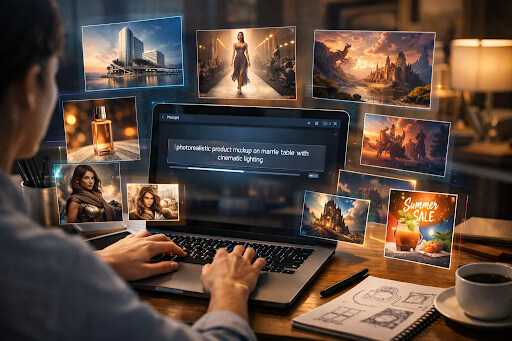
One of the most practical uses of Midjourney AI is product visualization. Businesses can generate mockups before a product even exists physically.
Typical product mockup use cases
- Packaging concepts for new consumer products
- Prototype visuals for e-commerce listings
- Early-stage branding experiments
- Advertising visuals before product photography
For example, a skincare startup might generate several packaging styles before committing to a final design.
Example workflow
- Write a prompt describing the product
- Include style instructions, such as lighting or background
- Generate several visual variations
- Select promising concepts for further refinement
A prompt could look like:
“Minimalist skincare bottle on marble surface, soft natural lighting, modern luxury branding.”
Within seconds, the system generates multiple visual options that help guide design decisions.
This approach allows teams to test visual ideas early in the development cycle.
How does prompt accuracy improve visuals?
Earlier AI tools sometimes struggled with complex descriptions. Recent updates improved prompt interpretation significantly.
Midjourney AI now handles multi-element prompts with better accuracy. Users can combine several concepts into a single instruction.
Examples of layered prompts
- Product + environment + lighting style
- Character + emotion + background setting
- Fashion design + material + runway setting
For instance:
“Luxury smartwatch on a dark studio background with cinematic lighting and metallic reflections.”
The AI understands these layered descriptions and generates more realistic compositions.
This improvement makes the system practical for real marketing use cases rather than experimental artwork alone.
What role do visuals play in marketing campaigns?
Visual storytelling is central to modern advertising.
Companies increasingly rely on strong imagery across multiple channels:
- Social media posts
- Website banners
- Advertising campaigns
- Email marketing graphics
- Product landing pages
A marketing team planning a campaign may generate multiple visual styles before choosing the final direction.
Example campaign concepts
- Lifestyle imagery featuring products in real environments
- Stylized hero images for website headers
- Fantasy-inspired visuals for brand storytelling
Because Midjourney AI can produce diverse styles quickly, creative teams often explore many visual directions before selecting the most effective one.
How does visual consistency help branding?
Maintaining a consistent visual identity across campaigns can be difficult. This is where the Omni Reference system introduced in Midjourney v7 becomes useful.
Omni Reference allows users to maintain continuity across generated images.
Benefits include
- Consistent characters across multiple scenes
- Uniform product appearance in different environments
- Matching visual style across campaigns
For example, a brand could generate a character mascot and use the same character across multiple promotional visuals.
This consistency helps build brand recognition.
How can AI images connect with video creation?
Images often serve as the starting point for video storytelling. Marketing teams frequently transform visuals into motion content.
In one example workflow, a marketing team used Midjourney AI within invideo to generate concept visuals for a campaign. Those images were then turned into short promotional clips using a free AI video generator, helping the team move from static design ideas to full marketing videos without rebuilding assets from scratch.
This type of workflow highlights how visual generation and video production increasingly connect within modern creative processes.
What types of visuals can be generated?
One of the strengths of Midjourney AI is its range of creative outputs. The system can generate visuals across many industries and artistic styles.
Common categories
- Photorealistic product photography
- Abstract art for branding
- Concept design illustrations
- Fantasy scenes and storytelling visuals
- Architectural renderings
- Fashion concept designs
Marketing specific visuals
- E-commerce product images
- Social media graphics
- Advertising banners
- Promotional artwork
- Brand storytelling visuals
Because the tool handles both artistic and commercial imagery, it appeals to both designers and marketers.
How fast is the generation process?
Speed plays a major role in creative workflows.
With Midjourney v7, images typically render in 20 to 30 seconds in Standard mode. This represents a 20 to 30 percent improvement over earlier versions.
For creative teams, that speed allows rapid experimentation.
Instead of producing a single design concept, teams can explore dozens of variations.
Example iterative workflow
- Generate initial concepts
- Adjust prompts for lighting or composition
- Refine color palette
- Produce final marketing visual
This iterative process often leads to more creative outcomes.
Why are startups and creators using it?
Startups and small businesses often operate with limited design resources. AI tools allow them to produce professional visuals without large teams.
Practical benefits for businesses
- Lower design costs
- Faster campaign development
- Rapid concept testing
- More creative experimentation
A small e-commerce brand launching a product line could generate dozens of visual concepts before investing in professional photography.
This flexibility helps businesses move faster while exploring creative directions.
Conclusion
In contemporary marketing, visual material is essential. Businesses need images for campaigns, product pages, and social media at a pace that traditional design workflows often struggle to match.
Midjourney AI offers a practical solution by converting text prompts into detailed visuals within seconds. With improved prompt understanding, faster rendering, and the Omni Reference system, the technology supports a wide range of creative tasks, from product mockups to full marketing visuals.
For marketers, designers, and entrepreneurs, the real value lies in experimentation. Instead of waiting days for a concept image, teams can explore dozens of visual ideas quickly and refine the best ones.
The story of AI image generation continues to evolve. It reflects a broader tale of success and innovation in creative technology, where ideas move from imagination to visual form faster than ever before.
As these tools become part of everyday creative workflows, one question remains worth discussing.
How will AI-generated visuals reshape the way brands design and communicate their ideas in the future?
Frequently asked questions
What is Midjourney AI used for?
Midjourney AI is used to generate images from text prompts. Businesses and creators use it for product mockups, marketing graphics, concept art, social media visuals, and design experiments. The system converts written descriptions into detailed visuals, allowing users to produce creative assets quickly.
Can Midjourney AI create product mockups?
Yes. Midjourney AI can generate realistic product mockups such as packaging designs, device renders, or ecommerce visuals. Businesses often use it during early product development to explore branding ideas before investing in photography or physical prototypes.
How fast does Midjourney AI generate images?
With the latest version, images usually generate in 20 to 30 seconds in Standard mode. This makes it possible to create multiple variations quickly, helping designers and marketers experiment with different visual styles.
What types of visuals can Midjourney AI produce?
The system can generate a wide range of visuals, including:
- Photorealistic product images
- Concept illustrations
- Architectural designs
- Fashion concepts
- Social media graphics
- Advertising artwork
This flexibility allows it to serve both artistic projects and commercial marketing needs.
Does Midjourney AI support consistent visuals?
Yes. The Omni Reference system introduced in version 7 allows users to maintain consistent characters, styles, or product appearances across multiple generated images. This feature helps maintain visual continuity in branding and storytelling projects.
Is Midjourney AI useful for marketing teams?
Marketing teams use Midjourney AI to generate campaign visuals, explore creative directions, and produce social media graphics quickly. The ability to create many variations from simple prompts helps teams test ideas before finalizing campaign assets.
Can Midjourney AI help with advertising campaigns?
Yes. Businesses often use Midjourney AI to generate early-stage advertising concepts, promotional visuals, and creative storyboards. These images help teams visualize campaign ideas before moving into full production.